
Dr. Toni Calabretti and Dr. Dr. Christoph Glaser on transition, leadership, and the future of WHU
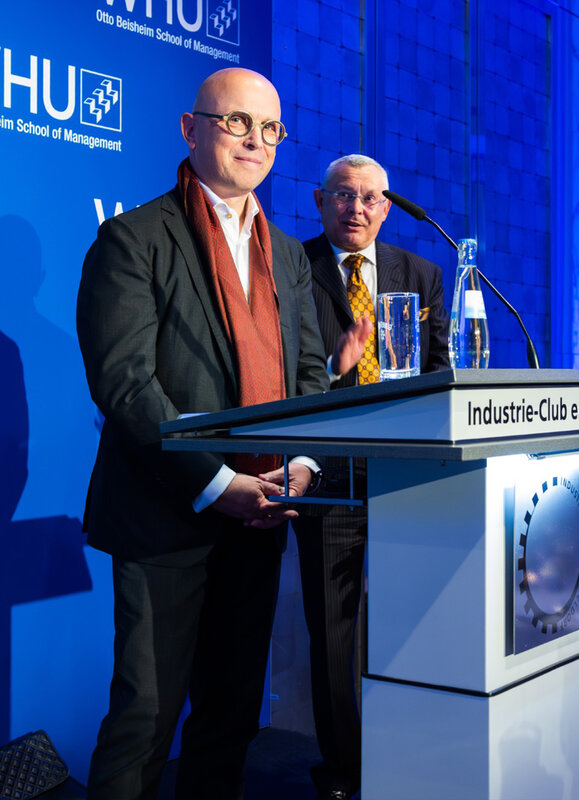
Dr. Dr. Christoph Glaser with Dr. Toni Calabretti
04/30/2026
Interview with Dr. Toni Calabretti and Dr. Dr. Christoph Glaser
At the beginning of the year, after more than 13 years as Chairman of the Board of the WHU Foundation, Dr. Toni Calabretti stepped down from this role. Since January 14, Dr. Dr. Christoph Glaser has assumed this central position for the university. Dr. Calabretti will remain affiliated with the Foundation as a member of the Board. In this joint interview, both reflect on responsibility, experience, motivation, and their vision for WHU's continued development.
Dr. Calabretti, Dr. Glaser, the transition at the top of the Foundation’s Board of Directors was initiated last year. What was particularly important to you during this transition?
Calabretti: The key for me was ensuring that everything we’ve built over these 13 years would be carried forward with the same commitment and passion. WHU is not just an institution – it is a community of people who believe in the power of education to change the world. What mattered most was that my successor shares that conviction. When I look at Christoph, I know that WHU is in excellent hands. Christoph has been a valued member of our Beisheim management team for several years and has been actively involved both in our Munich-based foundation and on the Investment Committee. We spent considerable time together before the formal handover, and I was struck by how deeply he understands not just the mechanics of the WHU Foundation, but its spirit.
Glaser: And from my side, what was most important was continuity – not just continuity of leadership, but continuity of trust: the trust of the faculty, the professional staff, the students, the alumni, and our partners. Toni’s legacy is very strong and remarkable, and I am very aware of this responsibility. The transition was thoughtfully prepared, which made it possible to move forward from a position of strength rather than uncertainty.
Dr. Calabretti, reflecting on more than 13 years leading the Foundation, what achievements are you most proud of?
Calabretti: What gives me the deepest satisfaction is watching WHU grow into a school that is genuinely shaping the next generation of leaders – and doing so with a very clear sense of purpose. When I look back at where WHU stood when I took on this role and where it stands today, I am proud of what this entire community has achieved together. The growth in our program portfolio, the strengthening of our international reputation, and above all, the quality of the people we are producing – graduates who go on to lead companies, shape industries, and contribute to society in meaningful ways. We are fortunate to have a highly committed faculty and administration, as well as an excellent Core Leadership Team (CLT). But perhaps most of all, what has brought me the greatest joy is the alumni community that has developed around WHU. These are people who carry the school’s values with them wherever they go.
Dr. Calabretti, what challenges have particularly shaped this period in your view?
Calabretti: Every era has its defining challenges. In my time at WHU, we navigated the transformation brought about by increasing competitiveness (in Germany but also internationally), digitalization, and more recently the upheaval of the pandemic, which forced the entire world of education to ask itself fundamental questions about the role and relevance of physical learning spaces. And that question is more pertinent than ever now, in the age of artificial intelligence. When you can access virtually any knowledge at any time, the question becomes: what is the unique value of a place like WHU? My answer is: the people, the community, the encounter. You cannot replicate the intensity of learning alongside exceptional peers, with excellent faculty, in a dedicated environment. That has been a constant thread: defending and deepening what makes us irreplaceable.
Dr. Glaser, what personally motivated you to take on the role of Chairman of the WHU Foundation?
Glaser: I have long been convinced that education – and particularly management education – is one of the most powerful levers we have for shaping a better society. But I think we are at a genuinely historic inflection point right now. Artificial intelligence is not just changing business; it is changing what it means to be a professional, what it means to lead, what skills are genuinely scarce and valuable. This is both a profound challenge and an extraordinary opportunity for a school like WHU. I wanted to be part of shaping how WHU responds to that moment. The vision we are working towards – where human talent meets future intelligence for the greater good – captures it well. It is not about replacing the human with the machine; it is about bringing the best of both together. That ambition is what motivated me to step forward.
Dr. Glaser, what topics would you like to prioritize in the coming years? And what decisions need to be made to ensure WHU remains successful in the long term?
Glaser: There are several areas where I believe we must be bold. The first is curriculum transformation. The skills that will define the most valuable leaders of the next decade are genuinely different from those of the past. We need graduates who can navigate complexity and ambiguity with real judgment – who can think in a systematic and interconnected way, collaborate across cultures and disciplines, and who combine strategic imagination with the ability to act and create lasting impact. These are not soft skills; they are the hardest and rarest competencies in any organization. Second, WHU must address the defining challenges of our time: the implications of exponential technology for governance and society, the need for economic models that are regenerative and sustainable, and the deeper question of what it means to be human and to lead with purpose and integrity in a world of rapid change. And finally, we must continue to strengthen the ties between WHU and its ecosystem of alumni, partners, and the broader business community. Any school is only as strong as the connections it forges to the real world – and those connections are what translate learning into genuine impact.
Dr. Calabretti, what advice would you give your successor as he takes on this role?
Calabretti: My advice – and I believe Christoph would agree that he would have given himself the same – is to never lose sight of the people. It is easy, in any leadership role, to become absorbed in strategy, in structures, in financial sustainability. All of those matter enormously. But the heart of WHU has always been the people: the students who arrive with great potential and leave transformed, the faculty who dedicate their careers to creating knowledge and passing it on, the professional staff, who are deeply committed to the university, the alumni who carry the WHU spirit out into the world. Stay close to them. Listen to them. And never stop asking whether what we are building is truly serving their growth and their potential to make a positive difference. The rest will follow.
Dr. Calabretti, Dr. Glaser, guided by the idea of ‘Alumni Impact’: How do alumni contribute to WHU‘s development, and where do you see potential for deeper involvement?
Calabretti: The alumni are, in a profound sense, the living proof of WHU’s values. Every time a WHU alumnus founds a company, leads a transformation, or builds something of lasting significance, that is WHU’s impact in the world. What I hope for is that the alumni increasingly see themselves not just as beneficiaries of WHU, but as co-creators of its future – as mentors, as knowledge partners, as ambassadors, and as active participants in the life of the school.
Glaser: I fully agree. And I would add that we are in a moment where the alumni can play an especially important role in bridging the academic world with the realities of business and society. The challenges we face – whether in technology, in sustainability, or in leadership – cannot be solved within the walls of any single institution. We need that dialogue, that exchange of perspectives, that connection between what is taught in the classroom and what is being experienced in the real world. I see enormous potential to deepen this partnership, and it is one of the things I am most eager to develop.
Dr. Calabretti, Dr. Glaser, when you step away from WHU matters – how do you most enjoy spending your time?
Calabretti: I have always found balance through sport and time in nature. There is something about physical movement and being outdoors that restores perspective and reminds you of what truly matters. And of course, time with my family – they have always been my anchor.
Glaser: For me, the same applies in many ways. I find that my best thinking happens when I am away from screens and meetings – whether that is traveling or simply having long conversations with people I find inspiring. I am also deeply curious about the intersection of technology and culture, so I find myself drawn to the broader questions of how human beings make meaning in the world. These are not separate from my work at WHU – if anything, they feed directly into it.
To close, Dr. Glaser: In light of the significant societal challenges facing Germany and Europe, where do you see WHU‘s potential to make a difference?
Glaser: Germany and Europe face a profound set of challenges. Our economic models are under pressure, our political systems are strained, and we are navigating a technological revolution whose full implications we have not yet grasped. In this context, I believe WHU can make a vital contribution in three areas. First: educating leaders who can navigate complexity with integrity – people who combine analytical rigor with genuine ethical judgment, who ask not just “can we do this?” but “should we do this?” and “what does this mean for the societies we are part of?” Second: fostering entrepreneurial thinking and the courage to create. Europe needs more people who see challenges as opportunities and are willing to take the initiative to build the solutions we need. That spirit of purposeful innovation is something WHU can nurture and amplify. And third: creating the spaces for the crucial conversations about the future – between business, government, academia, and civil society. WHU is well placed to be one of those spaces: a place where minds meet, where ideas are tested rigorously, and where the next generation of leaders develops not just skills, but wisdom.
Dr. Calabretti, Dr. Glaser, thank you for the interview!