
“The constant changes seen in the working world offer young people an array of opportunities”
06/03/2026
Five Questions for Dr. Michael Diederich
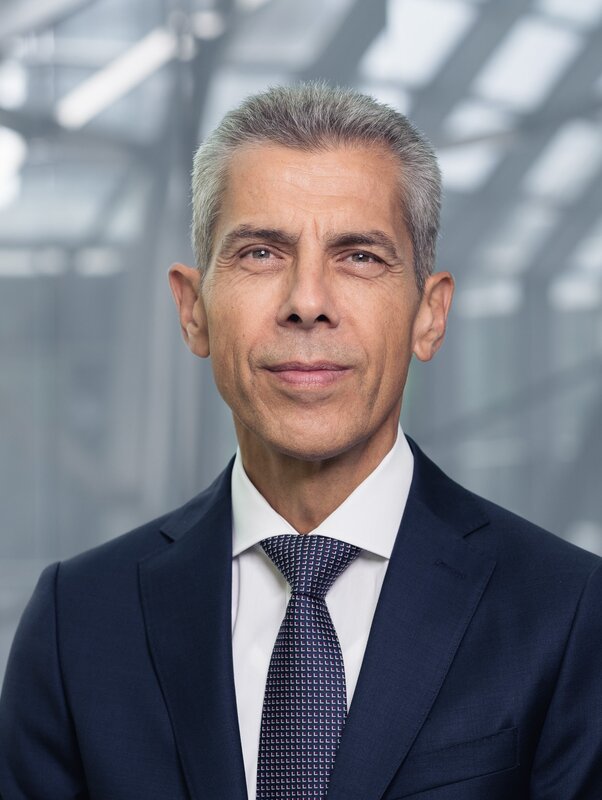
Dr. Michael Diederich graduated from WHU – Otto Beisheim School of Management in 1999 as one of the pioneers of the school’s EMBA Program. Today, he is a member of the Group Management Committee at Deutsche Bank, where he is responsible for the firm’s corporate client base and keeps his keen eye on the economy. Thanks to his continuous dialogue with large mid-sized companies, executives, and CEOs, he knows where the German and greater European economies stand, where they struggle, and in which areas one can justifiably hope for an upswing. In a new interview, the finance expert speaks on economic perspectives, the role of fintechs, and his experiences working with FC Bayern. He also offers a hopeful message for the young people now entering the job market.
Michael, you have spent the past year as the Co-Head of Deutsche Bank’s Corporate Bank, where you are responsible for business-to-business activity. In Germany, as well as in Europe, companies are going through a difficult phase in which economic growth has been significantly restricted. What do today’s companies need most to spark growth again?
There are three things I find the most relevant: First, companies these days need planning certainty and trust, as the world has become more volatile and unstable over time. For a long time, our world was defined by its unipolarity with the United States remaining its only true superpower. Before that, things were oriented in more of a bipolar fashion with two world powers. In today’s multipolar world, business has become significantly more complex with several actors, each with their own interests, ideas, and concepts. To be successful in such a market, you need to possess a high level of adaptability, efficiency, and resilience. I’m convinced that we in Germany, and across Europe, have the ingredients necessary to continue playing a leading role here. Second, companies need capital and an ability to invest. And third, and this goes to the heart of the matter, we need to act swiftly, execute our ideas, and make them reality.
All the conversations I’m currently having with business representatives lead back to those three topics. How safe are we in our planning? How much trust should we give our partners? How should we make capital available such that, say, the project or expansion can truly be financed in the end? And how can we gain momentum and scale so that we can take the ideas we have and turn them into reality? I’m wholeheartedly convinced that our problem is not that we don’t recognize these issues, but rather that we need to tackle them head-on and realize what we want to achieve.
AI-driven business models and fintechs are increasingly flooding the global market. Does this development pose a threat to traditional banking? And how does it need to adapt in order to meet the needs of this new reality?
I’m of several minds on this topic. A fintech, if we were to simplify things, can be customer, competitor, and partner—sometimes all three at the same time. Yes, we need to closely observe the fintech scene, but that same scene is keeping us agile. Everything we’re doing on the process side of things, how much we invest in optimization, bots, or other AI-related topics, is keeping us agile. Fintechs are certainly leaving an impression on today’s market.
But at the same time, it’s no secret that fintechs, such as Trade Republic, PayPal, Scalable, and others, are also our clients. We are actively working with these companies and we appreciate the collaboration with them.
In many respects, we’re also partners, meaning that this question cannot be answered with a one-dimensional response. In fact, this kind of competition is not a bad thing for large corporations, as it helps keep them agile.
In 2023, you briefly stepped away from banking and were the CFO and deputy CEO at FC Bayern until 2025. Do you see any parallels between banking and the world of football?
On one side, you have a highly regulated structure like a bank and, on the other, a highly professional sports club where regulation is not exactly the top priority (even though there were certain rules to follow). And there are other fundamental differences. If we think a bit abstractly, however, what banks and football clubs have in common is that you can only be successful if you’re part of the team.
Any sector where the products are rather homogenous is also where the team—and the interplay between teams across the organization—truly make the difference. And that’s where ambition comes into play.
Team, teamwork, and ambition: That is, from my point of view, what banking and the football world have in common and what makes the difference out on the field and in the daily operations of a bank.
In 1999, you were one of the pioneering students enrolled in the Kellogg-WHU EMBA Program, which had only been inaugurated the year before and was, at that time, hardly known in Germany. What were the most important things you took away from the program?
I took away this need to look at things more comprehensively and keep the bigger picture in focus. It was never about exploring just one discipline—“explain controlling to me, now explain just how to optimize supply chains, or marketing.” Rather, we were provided with recipes, so to speak, from the entire cookbook. What works best in a particular situation or when facing a particular challenge? What can you bring to the table in a way that everyone’s strengths complement each other? Working in interconnected, diverse teams is something that continues to shape who I am today.
Today, you would expect that, but at the time it wasn’t a given. Diversity is on everybody’s mind today. There are so many different personalities; everyone has their own valid stance on things that they want to bring forth. Listening to all these positions and managing peoples’ differing viewpoints in order to find better solutions is the decisive factor that determines a team’s success. That realization is something that has left an impression on me.
Back then, in the EMBA Program, it was an incredible experience to learn the material through real case studies as opposed to purely theoretical instruction. Plus, there was the network we were able to build—one that still holds strong today. Many of us are still in touch with one another, and the career paths of those in my network are often truly impressive. Whether in private equity, venture capital, start-ups, or major corporations, the network you’re able to build through the program is second to none.
We keep hearing that it is tough for young people just entering the job market. What advice would you give WHU students?
I believe there will always be a market for well-educated young people. And I also believe, especially looking at demographic trends in Germany and across Europe, that it will be nearly impossible for the young generation not to find their career paths. Because in the next four, five, six years, the baby boomers will all be retired. At the same time, though, we have to keep abreast of how AI is changing the world of work.
Ambition and having an interest in exploring new topics are what matter most. The generation coming aboard now is one that, naturally, makes use of chatbots and AI tools as part of their everyday lives. We need that input, because that’s the same generation that will, at some point in the future, shape banking and navigate modern banking practices.
A well-educated young person with a broad skill set will not find it hard to build a career simply because the working world is constantly presenting new challenges and changes. That’s why it’s important to invest in a strong, well-rounded education. You should explore a variety of things and remain open-minded, both geographically and in terms of the kind of work you do. That’s the advice I would like to share with young students.
Thanks for the chat, and we wish you a lot of success for the future.
You can read other “Five Questions for…” interviews here.
You can find more information about the Kellogg-WHU EMBA Program here.
Photo credit: Mario Andreya