
Why median startup funding can reveal more than averages, and what WHU’s €4.4m median says about fundraising capability and venture ecosystems.
09/01/2026
Venture Capital Math and WHU Startup Funding
Note: The following contributions are personal impulses from Max Eckel. They represent individual reflections and are intended to stimulate discussion and further thought.
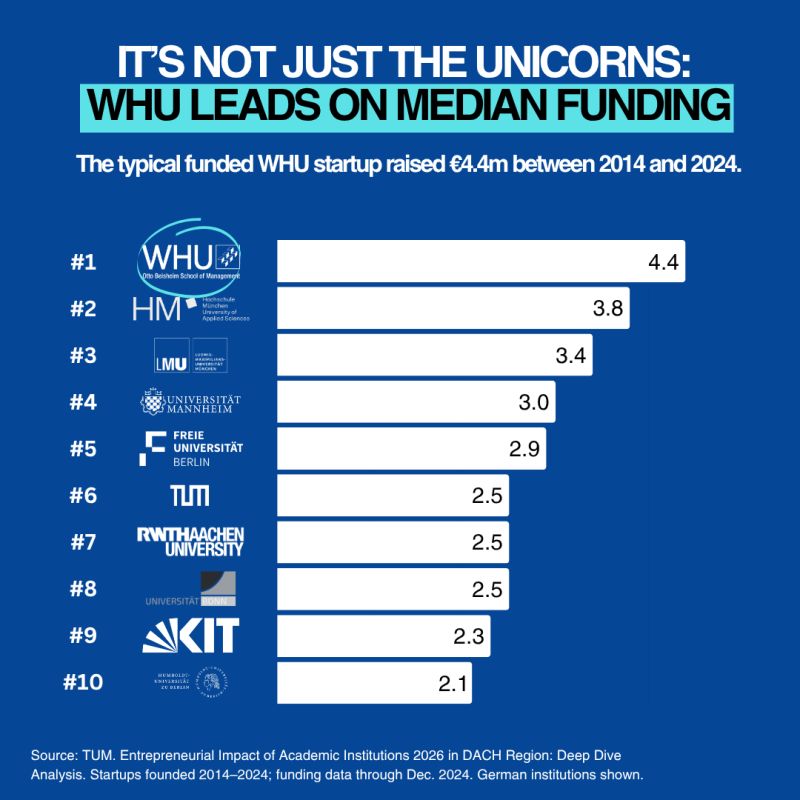
The average funded WHU startup raised €30.1m. That sounds great. It is also a slightly terrible number if you want to understand what a “typical” startup looks like. Because VC outliers destroy averages. The €4.4m median in this graphic is therefore the number I find more interesting. One company raising hundreds of millions can pull the average of an entire portfolio or university ecosystem upwards. And rather than a statistical problem, this is basically the whole point of venture capital.
Take a simplified €100m fund targeting a 3x return. One €5m investment returning 40x already creates €200m of portfolio value. A few companies can drive most of the outcome. The same goes for ecosystems: Celonis raised ~€1bn in 2021. All TUM ventures together raised ~€3bn that year. A crazy lighthouse. That has an important consequence for a VC: not every investment will become the outlier. Obviously. But every investment needs a credible path to becoming one. If the upside case is capped at “nice company, maybe 2x”, the venture math gets very difficult.
Founders choosing the VC path play the same game from the other side. You raise multiple times. Seed has to buy the proof point for Series A. Series A has to buy the next growth stage. Then B, C, D. Each round needs to de-risk enough of the company to convince the next investors to finance a much bigger version of it.
That’s why I keep telling founders: if you choose VC, fundraising is not finance admin. Fundraising is a core founder skill. Someone on the founding team has to become very good at it. Who to call. When to start. Which milestone investors need to see. How much to raise. When to walk away. And this is where ecosystems matter.
WHU ranks 2 on average funding per funded startup in the TUM study (behind LMU). Which could be reduced down to us having 18+ billion-dollar ventures. But this brings me back to the median. A lot of fundraising is tacit knowledge. You learn the game much faster when many people around you have raised before, invested before, or can route you to someone who has.
Among the German universities in the TUM analysis, the typical funded WHU startup raised €4.4m. 1 in the ranking, despite having the second most startups in Germany in absolute numbers in the study's timeframe. That doesn’t mean every WHU startup is a fundraising machine. But it does suggest that the capability goes deeper than a few famous outliers.
The outliers still decide the venture game. But there is a lot of value in creating enough shots on goal... and giving each of them the fundraising capability to stay in the game long enough to potentially become an outlier.