
A reflection on Rocket Internet, WHU’s startup ecosystem, and the future of founder apprenticeship in the AI era.
05/19/2026
WHU, Rocket Internet, and the AI Founder Era
Note: The following contributions are personal impulses from Max Eckel. They represent individual reflections and are intended to stimulate discussion and further thought.
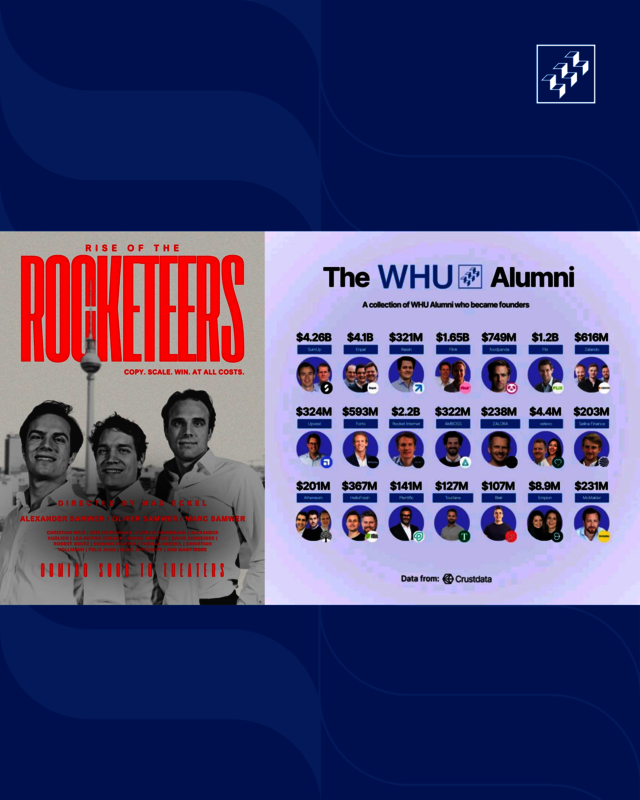
“The success of all these WHU founders is not really a WHU story. It is a Rocket Internet story.” That was roughly the comment I saw under a post about accomplished WHU alumni founders. I guess there is a version of this argument that is true.
Rocket Internet was probably one of the most important founder apprenticeship machines Germany ever had. For a long time, I even joked that Rocket was the unofficial Entrepreneurship Center of WHU. Not formally, obviously, but functionally. If you break Rocket down, it did many things a good founder environment should do. It put ambitious people into one peer group. It showed them what “good” looked like. It gave them playbooks, speed, pressure, examples, and guidance.
But then it also gave them a lot of agency. You could be young and suddenly responsible for a country, a category, a team, a launch, or an expansion. I've seen it with so many of my friends firsthand. That is why I think the comment is fair, but incomplete. You cannot cleanly separate WHU and Rocket.
Rocket was heavily staffed with WHU alumni, and that was not an accident. The Rocket universe actively pulled from that network because it found people who could operate in exactly that kind of environment. Rocket was one of the most powerful places where WHU talent got turned into company-building talent. Not the hidden variable instead of WHU. Ambitious people went in came out as founders, operators, investors, or sparring partners for the next generation.
But the more interesting part of the comment was not about the past. It was the challenge underneath it: “WHU's next decade depends on whether it can do the same with AI-native founders[...].” That is the question I care about a lot. I don’t think the answer is one new Rocket. The next version will probably be more distributed: stronger peer groups, more precise sparring, faster access to domain experts, more technical bridges, and more mentoring.
That is also what informs how I think about the WHU Entrepreneurship Center today. We are not trying to rebuild Rocket. We are trying to recreate some of the useful apprenticeship logic in a distributed way: a trusted network of high-profile sparring partners you get access to exactly when it matters the most. Media plays a role in that too. YC showed that founder culture travels through essays, videos, stories, and public advice that make useful patterns easier to copy.
The WHU flywheel clearly did not stop with Rocket. In the 2025 Entrepreneurial Impact Ranking, WHU ranked #2 in Germany in absolute startup output with 712 startups, despite being tiny compared to the big public universities. Rocket showed what concentrated apprenticeship can do. The next question is whether we can make apprenticeship distributed enough for the AI era.