Quantum Systems raised a €1.1bn Series D. Why a €100m SPV by a WHU alum highlights the evolving role of capital formation in Europe.
07/02/2026
Quantum Systems Series D and the Rise of €100m SPVs
Note: The following contributions are personal impulses from Max Eckel. They represent individual reflections and are intended to stimulate discussion and further thought.
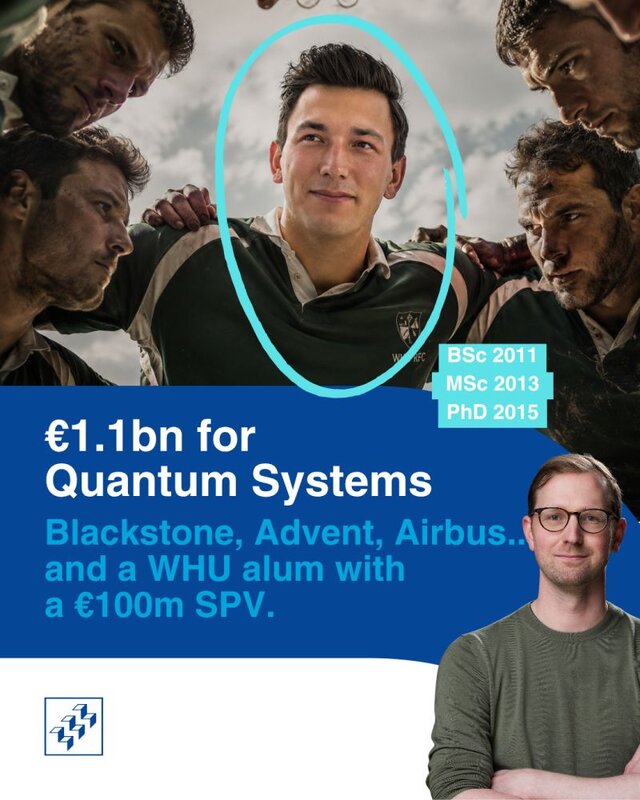
Blackstone, Advent, Airbus... and a WHU alum with a €100m SPV. That was the part of the Quantum Systems round I want to highlight today.
Quantum Systems just announced a €1.1bn Series D at more than €6.2bn post-money. They build autonomous systems for defence and security: drones, software, AI, hardware, production capacity, supply chains, delivery into allied markets. So, not exactly a “two people and a wrapper” startup.
Also: not a WHU venture… But Dr. Marlon Braumann (BSc 2011, MSc 2013, PhD 2015) is a WHU alum, and he had a pretty unusual role in this round. He created an SPV for the deal. In plain English, an SPV is a vehicle built for one specific investment. Instead of investors putting money into a fund and getting exposure to a whole portfolio, they pool money into one structure to invest in one company.
Basically: “I don’t want the basket. I want this company.” And then comes the insane part: Marlon told me his SPV was around €100m. That means this was not a small sidecar, not a few angels squeezing into an oversubscribed round, not someone forwarding a deck around WhatsApp.
It was an SPV in the same ballpark as some of the major institutional tickets in a round co-led by Blackstone, Advent, Airbus…That is capital formation at a serious level. And it matters because venture is an outlier game. For most funds, the dream is not that every company performs nicely. The dream is that one or two companies become so important that they return the fund.
Silicon Valley has been having this conversation around SpaceX, OpenAI and Anthropic for a while. Forbes recently had the wild argument that the potential VC payday from these three companies could outstrip a decade of startup exit returns. Menlo’s Anthropic bet is probably the cleanest SPV example. A huge direct conviction bet into a company that became one of the defining companies of this AI cycle.
That is why I find Marlon’s role in the Quantum Systems round so interesting. Europe talks a lot about needing generational companies. Fair. But we also talk about the lack of funding for such companies. And when such a company appears, someone also has to organize the capital around it: fast enough, credibly enough, and at a size that actually matters. It means understanding the company, the timing, the investor psychology, the legal structure, and the trust required to get people to move large amounts of money into one specific opportunity.
Marlon, congratulations. Calling this your “Meisterprüfung” in our conversation feels pretty accurate. European investor friends, honest question: when does an SPV become a real capital product, not just a way to squeeze into a hot round? Is it ticket size, speed, investor quality, clean structure, or whether the founder actually wants that group on the cap table?