
Europe needs new financing models for impact ventures. FASE and ECIIF II show how hybrid capital can mobilize private investment at scale.
09/17/2026
Hybrid Capital for European Impact Ventures
Note: The following contributions are personal impulses from Max Eckel. They represent individual reflections and are intended to stimulate discussion and further thought.
What if a company can create real impact, but is neither a VC case nor instantly bankable? Europe needs more capital products for companies that are too entrepreneurial for grants, too early for banks, and too different for VC.
Mario Kohle once said that capitalism and global finance are the most effective tools to combat climate change The same logic applies beyond climate tech. Education, care, health, circular economy, food systems... in many of these areas, the bottleneck is not only whether someone can build something useful. I think many of us had ideas for cool new products in these fields. It is whether the financing market has a product for that company.
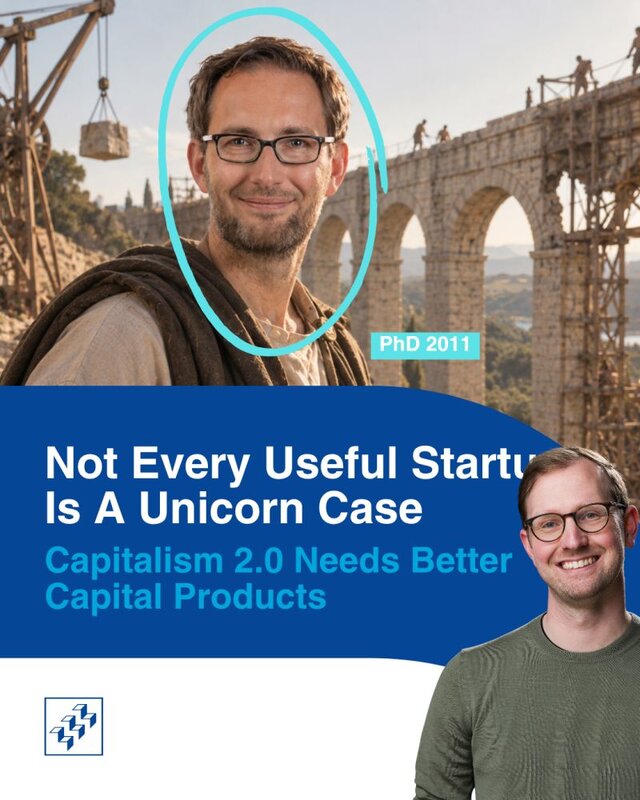
Dr. Markus Freiburg has been working on this frontier for more than a decade. Markus is a WHU PhD alum, worked at McKinsey, and wrote his doctorate on institutional investors in private equity funds. Together with Ashoka, he built FASE, the Financing Agency for Social Entrepreneurship. FASE helps impact ventures raise growth capital when the usual startup financing playbook does not fit: 100+ European impact ventures supported, €85m+ in hybrid growth capital mobilized.
Hybrid is the key word. Sometimes the right structure is equity. Sometimes mezzanine. Sometimes revenue-based financing. Sometimes patient capital. Sometimes the company is steward-owned or cooperative. Markus once described the core problem bluntly: “We see impact often as a measurement component but not yet as a decision element.” A lot of capital markets have learned to report impact after the money has moved. The harder question is whether impact actually changes where the money goes.
Now Markus and the team are taking this to the next level with ECIIF II. The European Catalytic Impact Investing Fund II just reached its first close at €21.45m, with a target size of €80m. It plans to back up to 40 European impact ventures across education, health, food systems and climate. Markus says FASE spent years trying to convince investors to become “impact-first investors,” and admits: “this doesn't work at scale.”
That's why it's a game-changer that ECIIF II benefits from a catalytic InvestEU guarantee by the European Investment Fund (EIF). A guarantee is someone credible saying: “If part of this goes wrong, we absorb some of the loss.” In this case, that someone is EIF. It lowers the downside enough that private capital can back companies it would normally avoid: too unusual for banks, too patient for VC, too important to leave unfunded.
Markus wrote that public guarantees “don’t sound like the fanciest and most innovative ingredient” but can “go a long way to derisk a portfolio and catalyze private sector investment.” Capital allocation as entrepreneurship. Building the financial plumbing that allows many companies to exist.
We are strong in startups, VC, PE and capital markets at WHU. But entrepreneurship should not shrink into one finance religion. Congrats Markus and the entire ECIIF team.