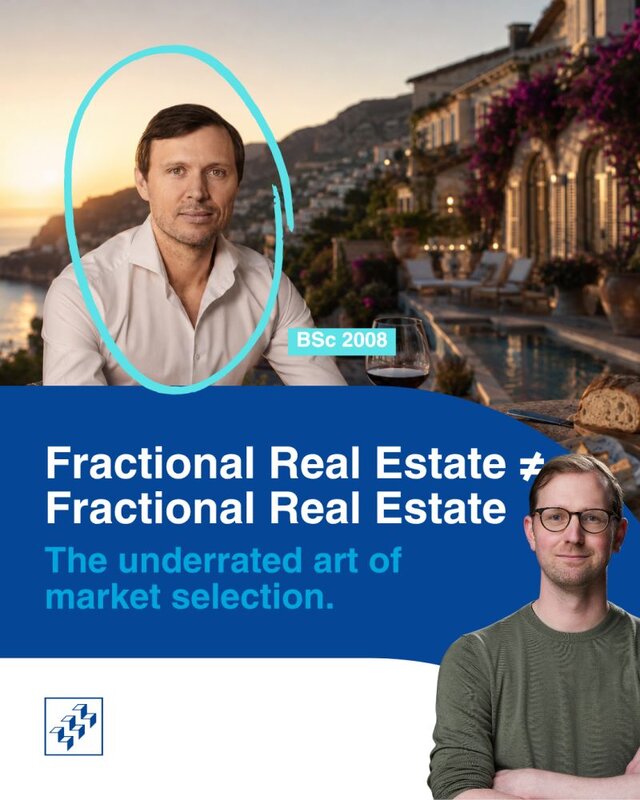
Why fractional real estate makes sense for holiday homes and what MYNE reveals about co-ownership, asset utilization, and startup niches.
08/31/2026
MYNE and the Logic of Holiday Home Co-Ownership
Note: The following contributions are personal impulses from Max Eckel. They represent individual reflections and are intended to stimulate discussion and further thought.
A €3m holiday home is a terrible product for someone who wants a few weeks of holiday… That sounds obvious. But listening to Nikolaus Thomale explain MYNE on Founder Mode helped me reflect on some pitches I had on my desk over the last few years. During the Web3 boom, I got a lot of pitches about tokenizing real estate.
The idea sounded sensible: real estate is expensive, so split ownership into smaller pieces and more people can participate. But I usually had the same question in my head: Why exactly is THIS property being fractionalized? Real estate has huge information asymmetries. If an asset is hard to sell normally, cutting it into 1,000 tokens and selling it to retail investors does not suddenly make it attractive.
Fractional ownership gets interesting when people genuinely want the asset (and just don't need 100% of it). That is why holiday homes make so much sense to me: People like owning “their” place in Mallorca, Kitzbühel or at a lake. But they may use it for only a few weeks a year.
MYNE says Europe has roughly 20–24 million holiday homes, and most stand empty around 80% of the time. Buying 100% of the asset is simply an inefficient way to consume 10–20% of the usage. That insight is also not completely new. I remember watching a Last Week Tonight episode about old-school timeshare not too long ago. With timeshare, you bought usage rights. However, with MYNE, you actually become a legal co-owner. The right to use it comes with ownership.
However, real ownership creates a much harder company to build. Someone has to make people trust a six-figure purchase, find and check properties, structure ownership, organize bookings, maintenance, local service providers and resale. Nikolaus says they reject at least 90% of the properties they see. Selected homes are tested with potential buyers before acquisition, and sometimes half the shares are already committed before MYNE buys.
It also reverses a trend I am highly skeptical about: We’ve all gotten used to owning less in exchange for more consumption. Music became Spotify. Software became subscriptions. Cars get leased. A hotel stay is pure consumption. You pay, sleep, leave. A holiday home is ownership, but massively underutilized.
Co-ownership sits somewhere in between: fees, maintenance, tied-up capital and property risk remain. But part of your holiday spending is connected to an asset you actually own, that might increase in value, and that you can trade. MYNE says it handled around €100m in asset value last year. Roughly a quarter of its co-owners have already bought a second or third share. Which I find a really convincing number.
And the broader startup lesson in this: “Fractional real estate” is a huge space. But office buildings, rental apartments and holiday homes behave very differently. Very often the opportunity is finding the niche where the mechanics actually work. That's true in cases like MYNE, but also crucial in deeptech spinoffs.