
WHU alum Matthias Heinrich Morales and his start-up Plato make Forbes 30 Under 30 list for Europe
07/23/2026
Five Questions for Plato
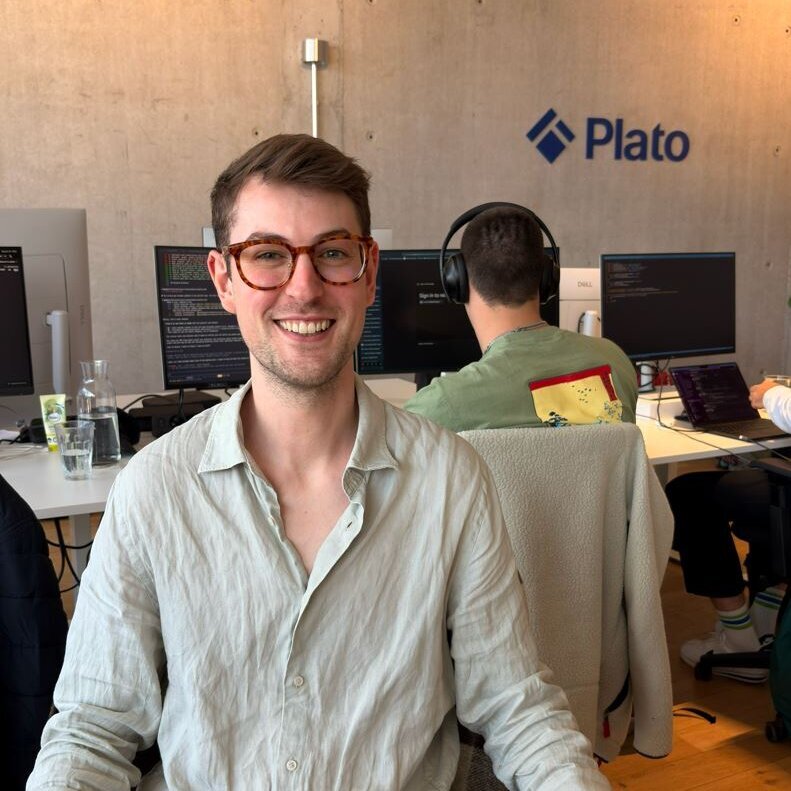
Matthias Heinrich Morales has accomplished quite a lot in a short amount of time, earning a bachelor’s degree from WHU in 2019 and making the Forbes 30 Under 30 list for Europe by 2026. Between then and now, in 2023, Morales also co-founded Plato with business partners Benedikt Nolte and Oliver Birch, a pursuit that has proven that even the rather traditional world of B2B wholesale is ready for change. The Berlin-based, AI-focused start-up targets these retailers and gives them an advantage by supplementing their preexisting company software, providing data-supported recommendations for both action and products, and saving sales teams on valuable time. In a new interview, Morales explains how to build a strong founder team, how AI will change how we work in the future, and how to find your way in the start-up scene.
Matthias, you earned your bachelor’s degree from WHU in 2019 and later co-founded Plato in 2023. When did you first realize you wanted to start your own company, and how did you find the right collaborators?
I can’t trace my decision to go into business for myself back to one specific moment. It was a bit of a slow burn. I had always had an incredibly strong interest in entrepreneurship and then naturally fell into the start-up scene at WHU. I helped organize IdeaLab! – WHU Founders’ Conferences and then started my first internship at Lesara in Berlin in 2017, which is when I realized just how incredibly exciting the world of start-ups and entrepreneurship can be. In the years that followed, I tried out a lot of different things, had other internships. It became clearer to me around that time that I wanted to build something of my own. It wasn’t a question of when, but rather a question of which sector I wanted to pursue.
My idea began to crystallize over time, and I eventually came to a point where I realized how much B2B targeted at small and mid-sized enterprises interested me. And that was one of the reasons why, after earning my bachelor’s degree at WHU, I went to get my master’s degree from the Technical University of Munich. I wanted to delve even deeper into the software sector. I met my future business partner Benedikt Nolte there through the CDTM, which is an interdisciplinary technology program in Munich. We worked together on projects and quickly realized that we complemented each other very well. Then, when he was working for McKinsey and I at Rocket Internet, we said to ourselves, “Okay, we want to build something of our own.” We met our third business partner Oliver Birch through my former boss at Rocket, and he was already well established in the tech sector. Today, I’m responsible for product development, and Benedikt manages sales, which works out perfectly.
What should entrepreneurs pay attention to when looking for the right business partner?
Once you know you want to start a company, the important thing is to get clear on how it is you want to go about doing it. Bootstrapping and venture capital, for example, are two entirely different worlds. It’s also crucial to identify your target demographic. At Lesara, I worked with consumers, and although I found data-driven work to be exciting, in the end, the B2C model wasn’t for me at all. It should be fun to spend time with your clients. In the best-case scenario, that will happen over an extended period of time to the point where you can draw a lot of energy from that particular demographic.
Before you do anything, though, you have to make sure that you and your co-founders are all on the same page and that you understand which values you all share. One thing we did as founders that I highly recommend is to fill out the co-founder survey offered by First Round Capital, which is a list of questions you should answer early on as opposed to later when you find yourself in a crisis.
Plato uses AI-driven analyses to help wholesalers automate tasks and give suitable product recommendations so that the B2B sales teams can concentrate more closely on the actual selling process. And that is meant to increase turnover and decrease costs. How did you and your partners come up with this business model?
It wasn’t so straightforward, as most people don’t have much exposure to wholesale in their everyday lives. But my co-founder Benedikt’s background comes from his family’s business, which is active in wholesale. So he was brought up in that world, discussing the ins and outs of it at the dinner table. With Plato, we’re dedicated to addressing a limitation of enterprise resource planning systems, or ERP systems for short, in the wholesale sector. Typically, they’re used for managing core business processes, such as tracking orders—but they don’t inherently encourage proactive action. Through my experience at Lesara, I realized how data-driven e-commerce can work. With the help of AI-driven analyses or even traditional machine learning models, you can create value and proactively generate actionable recommendations. So, then we said: It should be possible to do this in the B2B arena as well. We then built our first product, which integrates with the existing technology—in this case, the ERP system—and adds a proactive sales layer on top. So, the system offers a lot more than just administrative functions.
It seems that nearly every other start-up founded today focuses on AI or at least has AI as some part of their business model. Is AI a kind of Swiss army knife that can help significantly simplify or even render entirely obsolete the way we work?
AI is definitely quite a powerful tool. But we see a significant difference between our more traditional industry and the tech sector, where such tools get adopted far more quickly. At any rate, in both cases, AI is going to fundamentally change the way we work. I don’t believe that it will make work itself obsolete, however. There’s a lot of hype surrounding AI right now, and we have to be careful. We’ve always said that AI is no end-all-be-all solution; it’s just one way of generating more value for our clients. Of course, automating processes more and more is ultimately the goal. Especially with the current labor shortage, we’re going to have to invest more in automation in the future and conceptualize solutions in a more holistic way. But I’m convinced that the use of AI tools will allow today’s workers to better focus on more strategic decision-making.
Before founding Plato, you gained quite a lot of experience working with other start-ups, including Lesara and Rocket Internet, two businesses also founded by WHU graduates. Did WHU’s network make it easier for you to enter the start-up scene? And if so, how has that benefited your own business?
It absolutely helped make it easier to dive into the start-up scene. For me personally, it was considerably easier to secure an internship at a start-up founded by a WHU alum, although we also had career days on campus, when a whole host of other companies presented themselves to the students. I think the greatest advantage of WHU’s network lies in its access to the complete spectrum of business models. It also taught us how good start-ups operate and how to scale quickly. You get to see how such incredible companies across various sectors are built. I hadn’t even heard of Lesara before starting my internship there. And I also gained a better understanding of consumer business. By comparison, remberg, though it’s not a WHU start-up, was all about traditional SMEs. At Rocket Internet, where I got hired after graduation, I was involved in a lot of different areas. And that really helps you figure out what brings you joy and what doesn’t. That’s not something to underestimate when you’re starting your own company.
And the second way that WHU’s network majorly helped is that it gave me a path toward financial support. I mean, provided you come to the table with a solid business model and the fundamentals of your start-up are sound. Our first investor—Cherry Ventures—was also founded by WHU alumni and maintains strong ties to the school’s network. That made it easier to get an introduction than it might have been with other venture capital firms.
And given recent events, one quick bonus question: You made Forbes Magazine’s 30 Under 30 List for Europe for co-founding Plato. What does that recognition mean to you?
My first thought was “that’s my name there, but it’s an award that should go to the whole company.” Plato is not just me. It’s also my co-founders and a whole team of people, including our customers and investors, who believed in us right from the start. They all share a piece of that success. But of course, I’m still honored, particularly because we landed in the “Manufacturing and Industry” category. It shows that even a sector that is perhaps a bit traditional and conservative is still valued. What would make me happiest is if this public attention led to this sector, often perceived as somewhat less sexy than others, increasing in popularity in the start-up scene and attracting more talent and aspiring entrepreneurs. They would realize quickly that there are still considerable and highly relevant problems to be solved outside of the most hyped-up industries—and that companies like Plato and similar start-ups are doing just that and are always on the lookout for fresh talent.
Thanks for the chat, and we wish you a lot of success for the future.
You can read other “Five Questions for…” interviews here.
More information about WHU’s bachelor programs can be found here.