Explore why founders succeed through deep domain expertise or productive naivety—and why being half-informed is often the biggest risk.
07/03/2026
The Most Dangerous Founder Is Half-Informed
Note: The following contributions are personal impulses from Max Eckel. They represent individual reflections and are intended to stimulate discussion and further thought.
WHU Coaching Insight 1: The most dangerous founder is not the naive one. It is the one who is only half-informed.
Let me explain: There is one founder question I keep coming back to: What have you understood that all the other solutions have not understood yet? There is basically no real problem where nobody is already trying. If the problem is painful enough, there is usually an incumbent, three startups, a consultant, a feature inside a bigger tool, and some ugly Excel workaround already sitting there.
In my book, the interesting part is not that you saw the problem but why your answer should be structurally better. I recently had a discussion that made me think there are two very different ways founders get there.
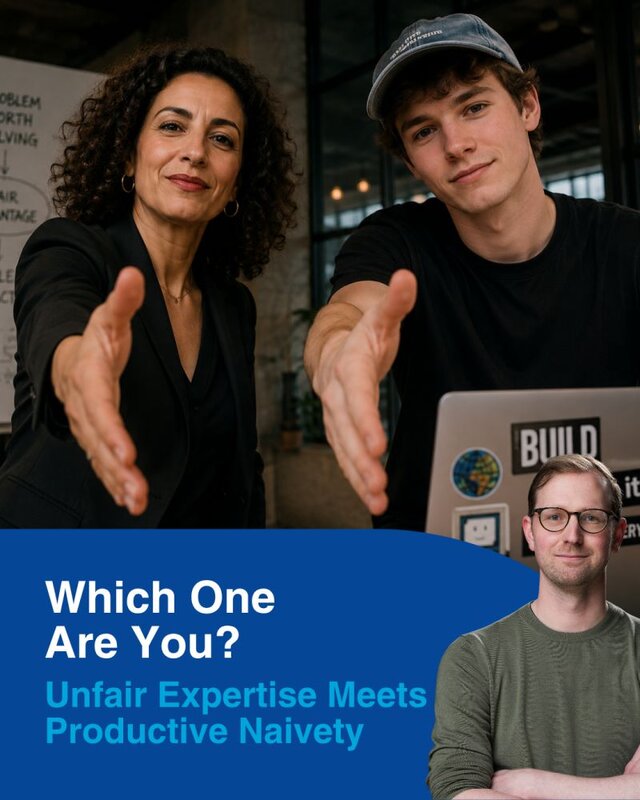
1. The first path is unfair expertise.
You spend years inside an industry. You sit in the procurement calls. You see where the ERP breaks. You understand why the official process and the real process are not the same thing. You know which stakeholder says “no”, which budget matters, and which workaround everyone uses.
This naturally favors more mature founders. They are not necessarily "smarter", but they have lived through enough repetitions to see the pattern. That is why I like founders who can explain a market in annoying detail. Margin pressure. Compliance. Distribution. Incentives. Buying behavior. The boring things that decide whether a company works.
2. The second path is almost the opposite.
You are young, naive, or simply outside enough that you do not respect the rules everybody else treats as laws.
“Why does it have to be sold through this channel?”
“Why is this manual?”
“Why do we assume the customer will never switch?”
“Why does the product need to look like every other product in the category?”
Sometimes this is stupid. Sometimes it is exactly the point.
A lot of experienced people confuse market wisdom with inherited constraints. And a lot of young founders confuse naivety with insight. The magic is knowing the difference quickly enough. At WHU, I see both paths all the time. Some founders win because they go absurdly deep into a niche and understand the customer better than anyone else. Others win because they look at a very normal industry and refuse to accept the emotional logic of “this is just how it works.” Both can work.
The dangerous middle is different: Founders who are neither deep enough to understand the system nor naive enough to challenge it. They just build a slightly cleaner version of what already exists. That is rarely enough. So maybe the founder question should be brutally simple: What do you know, or what do you refuse to believe, that makes your solution meaningfully different from everything already out there?
And for founders, investors, and operators here: When you see an exceptional startup early, is the stronger signal usually deep domain expertise, or productive naivety?