
A new study reveals how smart coordination of remote drivers, customer requests and vehicles can dramatically improve waiting times and service…
02/04/2026
New Publication: How Teleoperation Can Transform Urban Car Sharing
Car sharing has long promised more sustainable urban mobility by reducing private car ownership and the need for parking space. Yet many services struggle with a basic operational challenge: vehicles are often not where customers need them, leading to long walks, delays, or costly manual repositioning. A new study accepted for publication in Transportation Science, the flagship journal for transportation research in operations research, explores how teleoperated vehicles can fundamentally change this picture.
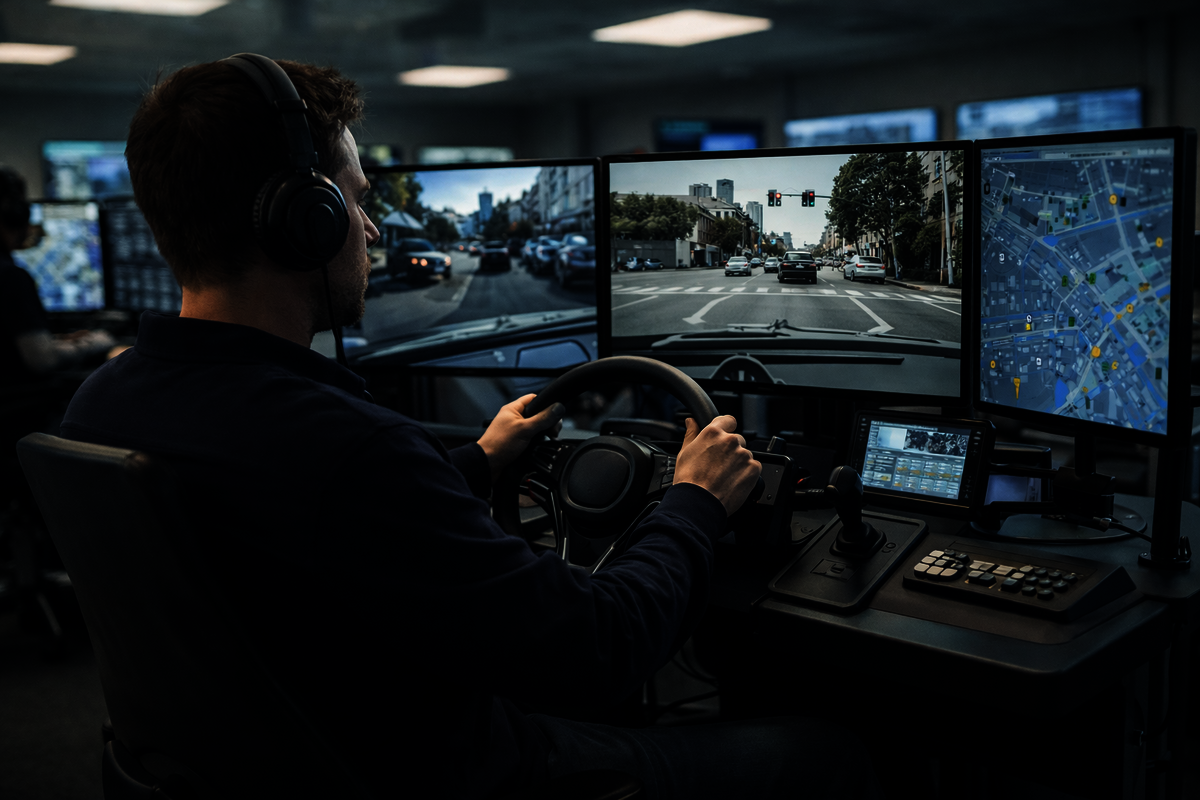
The article, “Dynamic Matching for Teleoperated Car Sharing Services,” by Gideon Gottschalg, Jarmo Haferkamp, Marlin Ulmer, and Arne Strauss, investigates car sharing systems in which vehicles can be remotely driven by human operators from a control center directly to customers. This emerging concept—already pursued by several mobility start-ups—eliminates the need for customers to walk to vehicles and reduces the reliance on on-site staff for fleet rebalancing.
The core challenge lies in deciding, in real time, which vehicle should be driven to which customer and by which operator—while future demand and future vehicle availability remain uncertain. The authors develop a data-driven decision framework that anticipates these uncertainties. By combining machine-learning predictions of when and where vehicles will be returned with an optimization approach that accounts for future consequences of current decisions, the method enables smarter, forward-looking matching decisions.
Using realistic demand data from New York City, the study shows that the proposed approach can reduce customer delays by more than 50% compared to simple, myopic decision rules. Importantly, it also prevents extreme waiting times and delivers a more equitable service across different parts of a city. One particularly relevant managerial insight is that teleoperation scales efficiently: in the studied setting, a single operator can effectively manage up to six vehicles without degrading customer experience.
The research highlights how advanced analytics and teleoperation can jointly make shared mobility services more attractive, efficient, and fair—offering concrete guidance for cities and mobility providers considering the next generation of car sharing systems.