
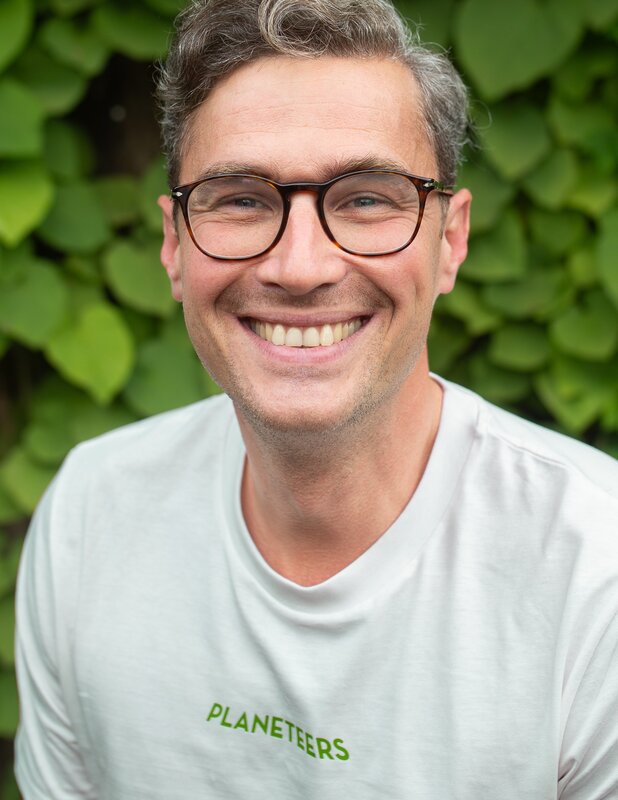
Florian Birner and his co-founders are working to curb climate change through an innovative method of storing carbon dioxide
03/12/2026
Five Questions for Planeteers
It sounds almost like a dream: filtering climate-damaging carbon dioxide from the air, converting it into mineralized water, and storing it safely and permanently in the ocean. Just as nature has been doing for millions of years, only much faster. This approach not only benefits the climate; the hydrogen carbonate produced during the process even counteracts ocean acidification.
This is precisely what Florian Birner (PTMBA 2017), Professor Jens Hartmann, and Dr. Frank Rattey, the founders of Planeteers, are working on. As brilliant as the idea may be and as enthusiastic as scientists are, climate change cannot be stopped so easily. A whole bundle of approaches is required, and this could be one of them. Carbon Capture and Storage, or CCS, appears promising, yet it still involves significant structural challenges. It will take time before the method can filter carbon dioxide from the air on a gigaton-scale worldwide.
Nevertheless, the now twenty-four-member team at Planeteers set out in 2022 to take on climate change. In this interview, Florian Birner explains how Planeteers intends to confront the climate crisis in the years ahead.
Florian, let us begin with your background. Your founding team at Planeteers covers a remarkably broad range of expertise: an industrial engineer at Airbus, a researcher and geochemist at the University of Hamburg. You yourself hold both an engineering degree and an MBA from WHU. Together, you bring more than sixty years of professional experience, which is far from typical for start-up founders. How does such a strong team come together? And does that impress investors?
It is true, we are no longer in our twenties. Interestingly, in our field of hardware start-ups, investors have viewed it rather positively. According to an analysis by Harvard Business School and the Massachusetts Institute of Technology, the most successful founders are often between thirty-five and forty-five years old.
That said, I do not believe success depends on age. What matters is how a team thinks about markets, products, solutions, and innovation. Regardless of age, a team must remain open to new perspectives.
We found each other through our network and through continuous exchanges of ideas. There was also a certain element of fortunate timing. The relevant people not only had the expertise, motivation, and enthusiasm for the topic, but it also aligned with their personal timing.
How did your studies at WHU influence your path as a founder tackling climate change?
During my studies, I experienced not only academic excellence and a strong network, but above all, an entrepreneurial mindset. That spirit was clearly present.
At the same time, it is evident that climate change will have a profound long-term impact on our daily lives, not only ecologically but also on society and the economy. Recognizing these shifts early and developing viable and scalable business models from them was one of the key lessons.
Entrepreneurship is not just about innovation. It is also about responsibility: seizing opportunities where societal and economic challenges are being redefined.
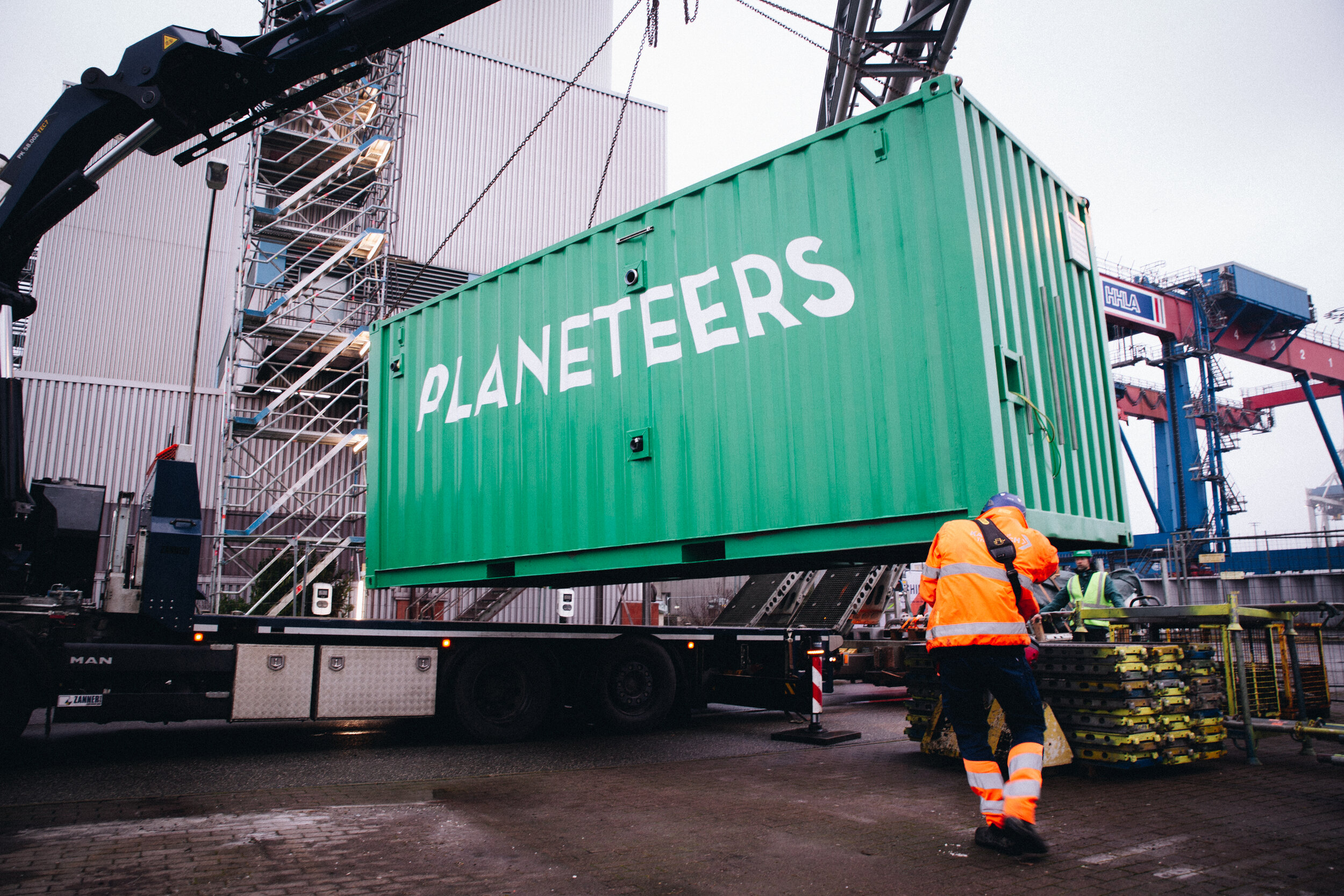
Planeteers was founded four years ago. What is your company’s ambition and how exactly does your technology work?
Our goal is clear. We provide companies with affordable, scalable technology that enables large-scale avoidance of carbon dioxide emissions.
This allows our clients to focus on their core business without having to deal with complex regulatory requirements, reporting obligations, or potential penalties. Climate protection thus becomes an integrated component of economic activity rather than an additional burden.
Our technology offers a decisive competitive advantage. Unlike many existing solutions, carbon dioxide does not have to be captured, transported, and injected into underground storage sites in several costly individual steps. Instead, it is converted directly into mineralized water in a single integrated process.
This approach reduces complexity, lowers costs, minimizes dependence on external infrastructure, and creates the foundation for true scalability.
Two successful funding rounds demonstrate investor confidence in your business model. You are already generating annual revenue of one million euros. Who are your clients, and how can your model be expanded in the future?
In the early phase, we deliberately invested significant effort in evaluating potential customers. We tested different industries and various contract and revenue models, and we generated initial revenue during that stage.
Today, we are in the production phase and can serve multiple clients simultaneously. This transition from validation to scaling marks a crucial milestone in our development.
Our technology addresses two distinct but closely connected markets. The first is the voluntary carbon market. In this market, companies purchase carbon certificates to voluntarily offset their emissions. The verification and validation of our carbon reductions are conducted by the independent auditing company Isometric, ensuring transparency and credibility.
The second and significantly larger market is the decarbonization market. In Europe alone, around 270 million tons of carbon dioxide are emitted each year which could, in principle, be avoided or stored. We help our clients prevent carbon dioxide from entering the atmosphere in the first place by storing it directly within the process.
Overall, we address a broad, highly fragmented market that represents a volume of around 45 billion euros in Europe alone, focusing only on customer segments that can use our technology efficiently. This highlights not only the scalability of our approach but also the substantial growth potential in a market that is gaining regulatory and economic importance.
CCS technology also has its shortcomings. Critics argue that it allows energy-intensive industries to buy certificates while continuing to burn oil and gas. How do you respond to this criticism?
The criticism is not entirely unfounded. At the same time, the industry faces ambitious targets under European Union regulations: emissions are to be reduced by 45 percent by 2030. Certain industries, such as lime and cement production or waste incineration, generate carbon dioxide as an unavoidable part of their processes.
Implementing these targets within ongoing industrial operations, particularly in hardware and plant-based environments, is highly complex. In many cases, it requires significant modifications to existing infrastructure, while technological alternatives are not yet fully mature or economically viable at scale.
This is precisely why pragmatic transitional solutions are essential. Solutions that are immediately effective can be integrated into existing processes giving companies time to prepare for long-term transformations.
The alternative would be inaction in the short- to medium-term. From our perspective, that would be not only environmentally problematic but also economically riskier. Transitional solutions enable substantial emission reductions today and build a bridge between regulatory ambition and industrial reality.
Thanks for the chat, and we wish you a lot of success for the future.
More ‘Five Questions For’ interviews can be found here.