
What WHU's move to Düsseldorf means for its students, alumni and startup ecosystem—and how it could transform entrepreneurship across NRW.
09.10.2026
WHU Moves to Düsseldorf: A New Chapter by 2034
Note: The following contributions are personal impulses from Max Eckel. They represent individual reflections and are intended to stimulate discussion and further thought.
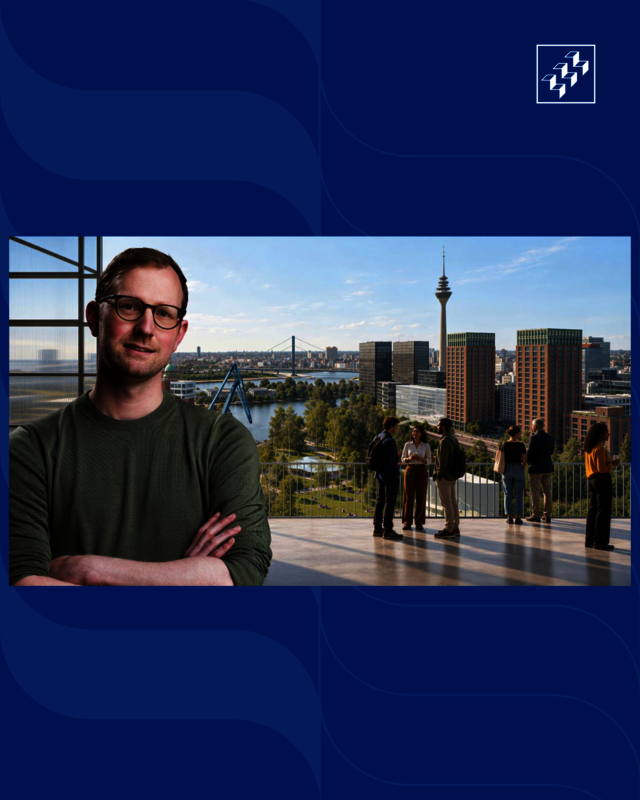
WHU is leaving Vallendar. Writing that still feels scary to me. By 2034, WHU plans to bring its activities together on a new campus on a peninsula at Düsseldorf’s media harbor. A new home for teaching, entrepreneurship, research and community.
Vallendar was never an obvious place to build one of Europe’s most entrepreneurial universities. Tiny town. No startup metropolis. No technical university next door. That was a weakness. And it became one of our biggest strengths. Because more than just studying at WHU, you lived WHU. You ran initiatives together. You met alumni. You argued about ideas in a study room and ended the night in the Korova Bar. You kept bumping into the same ambitious people until they became friends, co-founders, investors or sparring partners.
NRW has a similar strength-and-weakness problem. There is an insane amount of scientific and technological excellence: Aachen, Bochum, Dortmund, and many more places. But it is spread across a whole state. WHU can become a catalyst for that. By giving their most entrepreneurial researchers and technologists a second home.
Come to WHU for the business side. Learn how to turn technology into a company. Spend time around founders, investors and operators. Get exposed to a different level of commercial ambition. Build a network that complements the scientific one you already have.
There is a lot that is still to be decided. Especially for undergrads, WHU cannot become a place where everyone arrives for class and disappears afterwards. A lot of alumni were happy to hear the new campus is also supposed to have a real live-in element, including student housing. You cannot recreate WHU with lecture halls alone. Bring the Gewölbekeller. Bring Korova. Give student clubs space for even more spectacular conferences. Create open spaces where founders, alumni, students and people from outside WHU want to spend time.
Düsseldorf's mayor compared the project with the Rheinufertunnel and Wehrhahnlinie and said it could shape Düsseldorf for decades. Hendrik Wüst, NRW's prime minister, said: “No other university produces more start-ups in relation to its number of enrolled students than WHU.” Ina Brandes, NRW's minister of culture and science, basically said: NRW already has the research strength.
WHU knows how to turn ideas and scientific breakthroughs into business models and spin-offs. That is an extraordinary level of trust in our little institution. But it is recognition I've long believed WHU deserves. WHU is already one of the most astonishing institutions in Europe. And I still think we are only scratching the surface.
Leaving Vallendar scares me. But freezing WHU in place would scare me more. We have a once-in-a-generation chance to take what worked in a tiny town and make it a catalyst for an entire region.
Thank you Christian, the team, and the Beisheim Foundation for being ambitious and building what WHU can become with all of us.