
From protein engineering to quantum sensing: how Orbion is testing whether proteins can enable new ways to observe living systems.
07.10.2026
Orbion: From Protein Engineering to Quantum Sensing
Note: The following contributions are personal impulses from Max Eckel. They represent individual reflections and are intended to stimulate discussion and further thought.
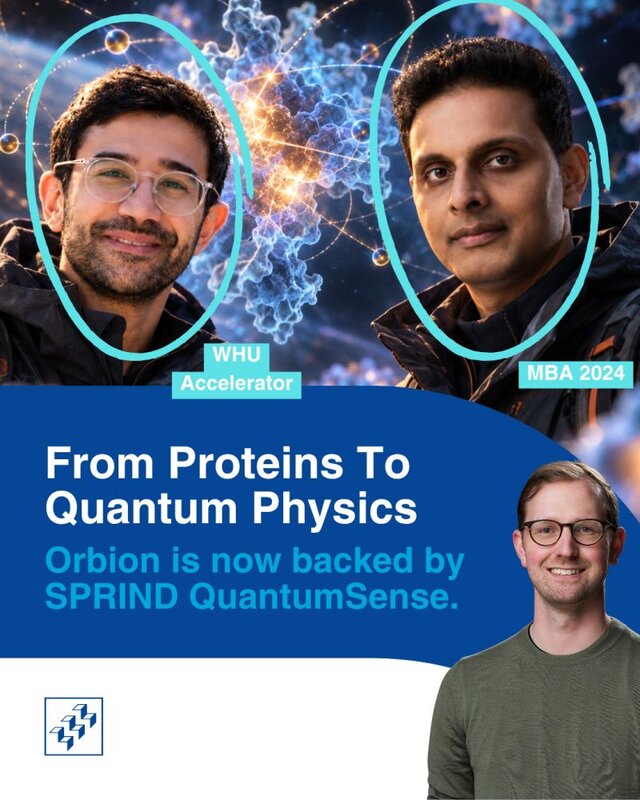
Recovering from a stem cell transplant is probably not the obvious moment to start learning quantum physics for an MBA graduate. But that is basically what Aniruddh Goteti did this year. I got to know Aniruddh and the founding team of Orbion in the WHU Accelerator. Antler had brought them together in Berlin. They were developing protein-engineering tools to help researchers predict which mutations are worth testing in the lab.
Then, last November, Aniruddh’s Hodgkin lymphoma came back. Stage IV. From December through March, he stepped away from full-time work for chemotherapy and a stem cell transplant at Charité. Çağlar kept Orbion moving: models, experiments, customers, product. And he gave Aniruddh space to explore a radical question during recovery.
Hospital life had made some questions personal. Repeated procedures and measurements can be burdensome. Could there one day be gentler ways to understand how cells change and respond to treatment? That somehow led back to proteins. And then to... quantum physics. Could Orbion’s tools help discover proteins with useful quantum properties? Some protein systems can change their fluorescence in response to magnetic fields. Cryptochromes, for example, are a candidate for how birds may sense the Earth’s magnetic field.
Aniruddh started digging into physics. He studied Computer Science before coming to WHU, which shows his interest in STEM topics... but this was still a whole different animal. What followed: Equations. Small quantum programs. A summer school in Malta. Conversations with people who work on this stuff. Then he brought together Prof. Robert Bittl at Freie Universität Berlin, Thomas Fay and Justin Caram at UCLA to test the idea experimentally.
And now Orbion has been selected for SPRIND - Bundesagentur für Sprunginnovationen’s QuantumSense Exploration program. SPRIND is Germany’s Federal Agency for Breakthrough Innovation. This program is looking for radically new quantum systems and sensing principles, not slightly better existing sensors. Long term, the ambition is protein-based sensors that could help us observe living systems in new ways. But first they have to prove the basic thing works: find proteins whose fluorescence responds to magnetic fields, predict which are worth testing, and validate the response experimentally.
Nobody in this story did everything. Antler got two founders into the same room. Çağlar kept the company moving and gave Aniruddh room to explore. Aniruddh learned his way into a field he had never formally studied. The researchers brought the experimental depth. SPRIND selected them to test whether this strange idea works.
Aniruddh, I’m very happy you’re here to tell this story. And Çağlar: huge respect for carrying so much while Aniruddh couldn’t. Now, I'm just excited that a WHU startup is operating in such a fascinating space. Godspeed!