
Reflections on deeptech, open source, and why UMH could enable an ERP moment for manufacturing data.
15.01.2026
Deeptech, Open Source, and the ERP Moment in Manufacturing
Note: The following contributions are personal impulses from Max Eckel. They represent individual reflections and are intended to stimulate discussion and further thought.
I used to run startup coaching in Aachen: Best part: being surrounded by engineers all day. Worst part: being surrounded by engineers all day. Because deeptech is not “software, but harder”. It’s a different game. For founders... and for investors.
Back then, many teams I worked with were building real things: machines, industrial systems, deep tech. Their frustration was rarely the technology. It was that so few investors in Germany were actually tuned to that game. Long timelines. Real technical DD. Deep involvement beyond board meetings.
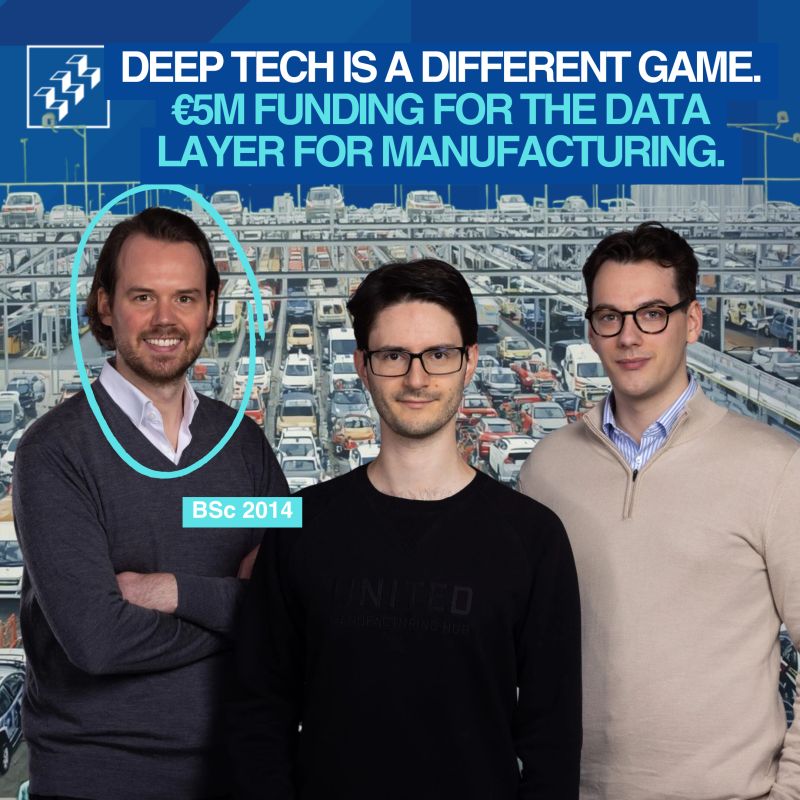
That’s why I always liked watching Niklas Hebborn (BSc 2014) and the Freigeist team from the sidelines. As Niklas described recently at Startup Insider, Freigeist did only two or three deals per year and stayed “very close to the founders, actively helping to build the companies.” Because it was their own capital, that selectiveness wasn’t optional. And Niklas never wanted to be the “board meeting to board meeting” investor. The operating side was always his real passion.
Now Niklas has switched sides and joined United Manufacturing Hub (UMH) as CCO & Managing Director... which is not a leap into the unknown. Freigeist invested in early 2024, and Niklas basically had a “super due diligence” phase over 1.5 years before going all-in. In many factories, people still know in the evening how much they produced. But “what actually happened in between… many still don’t know.”
UMH is building the data layer underneath manufacturing. Not a one-off use case. A foundation others can build on. And the wedge is OpenSource. Not out of ideological reasons, but strategic ones: In a world of Siemens, Rockwell, and hyperscalers, openness creates trust and independence. UMH built a community of 1,000+ people actively using their solution, giving feedback, breaking things. That’s basically a product team you don’t hire with a seed round. (With Langfuse and Marc Klingen, we have another venture following this strategy.) So, early on, the big question was not product, but commercialization: Would customers actually pay.
And now they raised €5m to go from “this works” to “this scales”. And there is so much potential: According to Niklas, we never really had an “ERP moment” for manufacturing data. Decades ago, business software standardized around shared data models. A core layer emerged, and ecosystems formed on top of it. SAP won by becoming the system of record.
In IndustrialData, that blueprint still doesn’t exist. An “ERP moment” here would mean a widely accepted data layer between machines and applications. A common structure. Fewer point-to-point integrations. If that moment comes, everything else accelerates. And Germany is a very credible place to build it. We have the factories. The engineers. Decades of industrial reality. Feels like one of those quietly important problems. Interested to hear opposing views.